
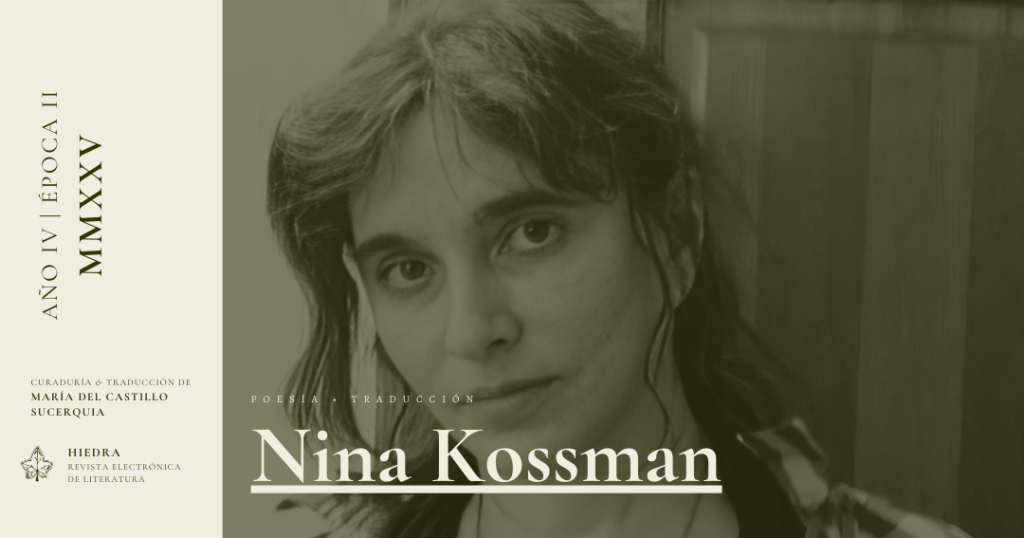
Selección de poemas inglés/español de la autora Nina Kossman en nuestra Hiedra. Gracias a la curaduría y traducción de María del Castillo Suserquia.
| 1.221 lecturas |
TIME OF RETURN
I’m a backward
sound of myself.
I twist, I turn
through sheer virulence
of habit sleep
that measures time
in bursts of agony.
I ask, I bless.
I speak the raw material of memory:
only flowers here still recall the dead.
This hour of the soul
I am a green begonia,
a red petal
on the stem of morning.
Sweet hour of return,
save me from these shattered
words, repetitive illusions.
I am dark, uncountable.
I am the meaning of a syllable
the ancients said and dropped.
I am the one the clouds dream of
when their vapor eyes are shut.
The weeping wall, the nakedness of heart…
Disinterestedness, now let me go.
You said: it’s guaranteed–
the backward glance, the exit,
the twisting back, back, back…
Now let me go, beauty grass.
Your kisses pain me
like all that dies pains that which doesn’t.
I am the eye-nerve of your marriage,
grassy sky.
I ask, I bless.
I am a friend to everything that’s mortal.
I beg you: do breathe me in
and let me disappear in you:
Forever, earth.
Forever, sky.
* * *
HORA DEL REGRESO
Soy el eco
de mí misma.
Me retuerzo, giro
a través de la virulencia
del sueño habitual
que mide el tiempo
en estallidos de agonía.
Pregunto, bendigo.
Habito la materia cruda de la memoria:
Solo las flores recuerdan a los muertos.
En esta hora del alma
soy una begonia esmeralda,
un pétalo rojo
en el tallo de la mañana.
Dulce hora del regreso,
sálvame de estas palabras rotas,
ilusiones repetitivas.
Soy oscura, incontable.
Soy el significado de una sílaba
que los antiguos dijeron y dejaron caer.
Soy aquella que las nubes sueñan
cuando sus ojos de vapor están cerrados.
El muro que llora, la desnudez del corazón…
Desinterés, déjame ir ahora.
Dijiste: está garantizada:
la mirada hacia atrás, la salida,
el giro atrás, atrás, atrás…
Ahora déjame ir, hierba hermosa.
Tus besos me duelen
como todo lo que muere duele a lo que no muere.
Soy el nervio-ojo de tu matrimonio,
cielo de hierba.
Pregunto, bendigo.
Soy amiga de todo lo mortal.
Te ruego: respírame
y déjame desaparecer en ti:
Ser, por siempre, tierra.
Por siempre, cielo.
CONVERSATION WITH THE EARTH
I asked the Earth:
“Are you ready?”
and the Earth thought
I was asking if it was ready to die.
So I hurriedly said, “Sorry,
that’s not what I meant at all.
I simply asked,
“Are you ready?”
And the Earth replied,
“I’m ready, but it is not I
— no, no, not I —
who is going to die
but you—you—you.
I will be merely transformed
and no longer fit to live on,
and all the creatures that live
on me—and off of mе—will perish,
including you—you—you.”
Then the Earth asked me:
“Are you ready?”
And I said no, I’m not ready to die.
And the Earth said,
“You should hurry, it’s time,”
and I said, “Forgive us,
for we know not what we do to you.”
And the Earth whispered,
“Goodbye.”
* * *
CONVERSACIÓN CON LA TIERRA
Le pregunté a la Tierra:
“¿Estás lista?”
y la Tierra pensó
que le preguntaba si estaba lista para morir.
Rápidamente dije: “Perdón,
no era eso lo que quería decir.
Solo pregunté,
¿Estás lista?”
Y la Tierra respondió,
“Estoy lista, pero no soy yo:
no, no, no soy yo
quien va a morir,
sino tú, tú, tú.
Yo solo seré transformada
y ya no seré apta para albergar la vida,
y todas las criaturas que viven
sobre mí, y de mí, perecerán,
incluyéndote a ti, ti, ti”
Entonces la Tierra me preguntó:
“¿Estás lista?”
Y yo respondí: no, no estoy lista para morir.
Y la Tierra dijo,
“Deberías apurarte, es tiempo.”
Y yo dije, “Perdónanos,
porque no sabemos lo que te hacemos.”
Y la Tierra susurró,
“Adiós.”
I, WHO WAS NOT KILLED IN ANY WAR
And I, who was not killed in any war,
who did not march with an army of any motherland,
who did not hide in a trench because I took no sides,
since I had escaped from the motherland’s steel clutches
(this motherland or that, makes no difference anymore,
“motherland” being a figment of the imagination of the crowd,
and the crowd, by definition, is incapable of thinking,
it takes on faith catchwords handed down by its king);
since I escaped all rulers at an early age, I am free
from the crowd’s narrow-browed definition of every word,
I am beholden to slogans neither of the right nor of the left,
both seem tedious to me, like an undercooked oatmeal,
which the collective mind transforms into the best of viands.
I repeat: I was not killed in any war because, like kolobok*,
I escaped from the old man, the bear, and the wolf,
and there is no one to tell me what to think.
I think for myself: it is no small feat, things being what they are.
I am free to walk in no one’s woods, because I belong to no one,
except myself.
*Kolobok – a round bun, a character in Russian fairy tales, like the Gingerbread man
* * *
YO, QUE NO FUI MUERTA EN NINGUNA GUERRA
Y yo, que no fui muerta en ninguna guerra,
que no marché con el ejército de ninguna patria,
que no me oculté en una trinchera por no tomar partido,
y que escapé de los férreos tentáculos de la patria
(esta patria o aquella, ya da lo mismo,
“patria” es un artificio de la imaginación de la multitud,
y la multitud, por definición, es incapaz de pensar,
y toma como fe las palabras dadas por su rey)
y hui de todos los gobernantes desde joven, soy libre
de la estrecha definición de cada palabra que impone la multitud;
no me debo a consignas ni de la derecha ni de la izquierda,
ambas me parecen tediosas, como una avena mal cocida,
que la mente colectiva convierte en el mejor de los manjares.
Repito: no fui muerta en ninguna guerra porque, como kolobok*,
escapé del viejo, del oso y del lobo,
y no hay nadie que me diga qué pensar.
Pienso por mí misma: no es poca hazaña, considerando la situación.
Soy libre de caminar por los bosques de nadie,
porque no pertenezco a nadie, salvo a mí misma.
*Kolobok: un bollo redondo, personaje de los cuentos rusos, similar al Hombre de Pan de Jengibre.
In the city of Delphi,
where bloody games
take the place of prophecies
and of peaceful games,
shadows of priests and Pythias*,
and of those who, for prophecies,
paid only what they could—
a slave, a rooster, a horse, a coin;
in the city of Delphi
life is like an old net,
only tourists and guides get caught in it.
And I, too, am caught in this tattered net.
I can’t untangle it,
can’t figure out where am I,
where is the Pythia,
where’s the priest,
where’s the rooster,
where’s the horse,
where’s the coin,
and whose voice is whispering to me:
— Stay,
you yourself are the Pythia.
As for the coin and the horse,
forget them.
* Pythia (or Oracle of Delphi)—priestess dedicated to Apollo
* * *
En la ciudad de Delfos,
donde los juegos sangrientos
reemplazan las profecías
y los juegos pacíficos,
abundan sombras de sacerdotes y pitonisas,
y de aquellos que, por profecías,
pagaban lo que podían:
un esclavo, un gallo, un caballo, una moneda;
en la ciudad de Delfos
la vida es como una vieja red,
solo los turistas y guías se enredan en ella.
Yo también estoy atrapada en esta red.
No logro desenredarla,
no logro saber dónde estoy,
dónde está la pitonisa,
dónde está el sacerdote,
dónde está el gallo,
dónde está el caballo,
dónde está la moneda,
y de quién es la voz que me susurra:
Quédate,
tú misma eres la pitonisa.
Olvida la moneda
y el caballo.
NINA KOSSMAN
Refugiada judía de la antigua Unión Soviética. Poeta bilingüe, escritora de memorias, traductora de poesía rusa, pintora y dramaturga. Autora de tres libros de poemas en ruso e inglés, dos volúmenes de traducciones de poemas de Marina Tsvetaeva, dos libros de cuentos, una antología que preparó para Oxford University Press, varias obras de teatro y una novela. Su obra ha sido traducida al francés, griego, japonés, español, hebreo, persa, danés y holandés. Sus poemas y cuentos rusos han sido publicados en las principales revistas literarias rusas dentro y fuera del país. Recibió el Premio de Cuento Corto UNESCO/PEN, una beca NEA y becas de la Fundación para la Cultura Helénica, la Fundación de Beneficio Público Onassis y la Fundación Valparaíso. Su idioma nativo es el ruso, pero tiene vínculos profundos con Ucrania y Letonia; sus bisabuelos maternos vivían en Ucrania y sus abuelos paternos vivían en Letonia, donde perecieron durante el Holocausto. Su sitio web es https://ninakossman.com/

